 ultimate-guide
Identifying Ethically Sourced Coffee Beans: 2026 Guide
Table of Contents
- Why Identifying Ethically Sourced Coffee Beans Is Harder Than It Looks
- Fair Trade Coffee Certification Requirements Explained
- Direct Trade vs Fair Trade Coffee: Which Model Pays Farmers More?
- How to Read Coffee Roaster Transparency Reports
- A 7-Step Checklist for Identifying Ethically Sourced Coffee Beans
- The Carbon Footprint of Shipping and Roasting: What Ethical Sourcing Often Misses
- Frequently Asked Questions
Last Updated: September 21, 2026
Why Identifying Ethically Sourced Coffee Beans Is Harder Than It Looks
Identifying ethically sourced coffee beans means verifying a bag's claims about farmer pay, labor conditions, and environmental impact. This guide from The Gilded Cafe' Co. covers certifications, trade models, and label audits.
Fair Trade Coffee Certification Requirements Explained
Fair trade coffee certification requirements center on a guaranteed minimum price, a social premium on top of it, and independent audits of farms and cooperatives.
What Fairtrade Actually Guarantees Farmers
Fairtrade guarantees a minimum price, a separate premium for community projects, and prohibitions on forced labor and child labor. It does not guarantee a living wage, which is a different and higher bar.
The Living Wage vs. Fair Trade Price Distinction
A certification's minimum price is a floor tied to the commodity market. A living wage is a household budget calculation, what a family in a specific region needs for food, housing, healthcare, education, and savings. A bag can satisfy the first while failing the second.
Here's how the gap shows up in practice:
- The floor moves with the market, not with costs. When the commodity price falls, the floor holds at a level set years earlier, while local costs for fertilizer, labor, and food have risen.
- The premium is paid to the cooperative, not the farmer. Social premiums fund wells, schools, and equipment, real benefits, but community assets rather than cash in a farmer's pocket at harvest.
- Smallholder math is unforgiving. A farmer with two hectares produces a fraction of what a large estate does. Even a price above the floor can leave that household short once input costs and debt are subtracted.
- "Living wage" on a label is usually a roaster's own claim. No single certifying body audits and stamps a living-wage guarantee the way Fairtrade stamps a price floor. Look for the methodology: which region, household size, cost-of-living data, and who verified it.
How to Tell Which One a Bag Is Actually Promising
When a roaster uses wage language, sort the claim into one of three buckets:
- Certified price floor, verifiable through the certifier's public standards and the license number on the bag.
- Self-reported living wage, requires the roaster to publish the region, the methodology, and the number. If any of those is missing, treat it as marketing.
- Vague "fair pay" language, no floor, no methodology, no number. This is the weakest tier and the most common.
Direct Trade vs Fair Trade Coffee: Which Model Pays Farmers More?
Direct trade vs fair trade coffee comes down to who sets the terms. Fair Trade uses a third-party certification with a published price floor. Direct trade skips the certifier and relies on a roaster's own relationship with farmers, which can pay more but offers no independent verification.
| Model | Price Protection | Verification | Farmer Upside | Main Risk |
|---|---|---|---|---|
| Fair Trade | Published minimum price plus premium | Third-party audit | Stable, predictable income | Floor may lag living costs |
| Direct Trade | Negotiated per roaster | None, or self-reported | Potentially higher prices | No proof behind claims |
The Living Wage Gap Neither Model Fully Closes
Neither model reliably closes the gap between a fair price and a living wage. A price floor can still leave a smallholder short of a family's actual costs, and direct trade agreements vary wildly in what they pay.
How to Read Coffee Roaster Transparency Reports
A coffee roaster transparency report is a document, usually published on the roaster's website, that discloses farm names, prices paid, and sourcing relationships, the raw material to check their claims.
What to look for, in order of importance:
- Named farms or cooperatives, not vague regions
- Prices paid relative to the commodity market, ideally with a stated figure
- The length of the relationship with each producer
- Certification status and which body issued it
- Harvest dates tied to specific lots
A 7-Step Checklist for Identifying Ethically Sourced Coffee Beans
Use this checklist every time you evaluate a new bag. It takes about ten minutes and catches most greenwashing before you spend.
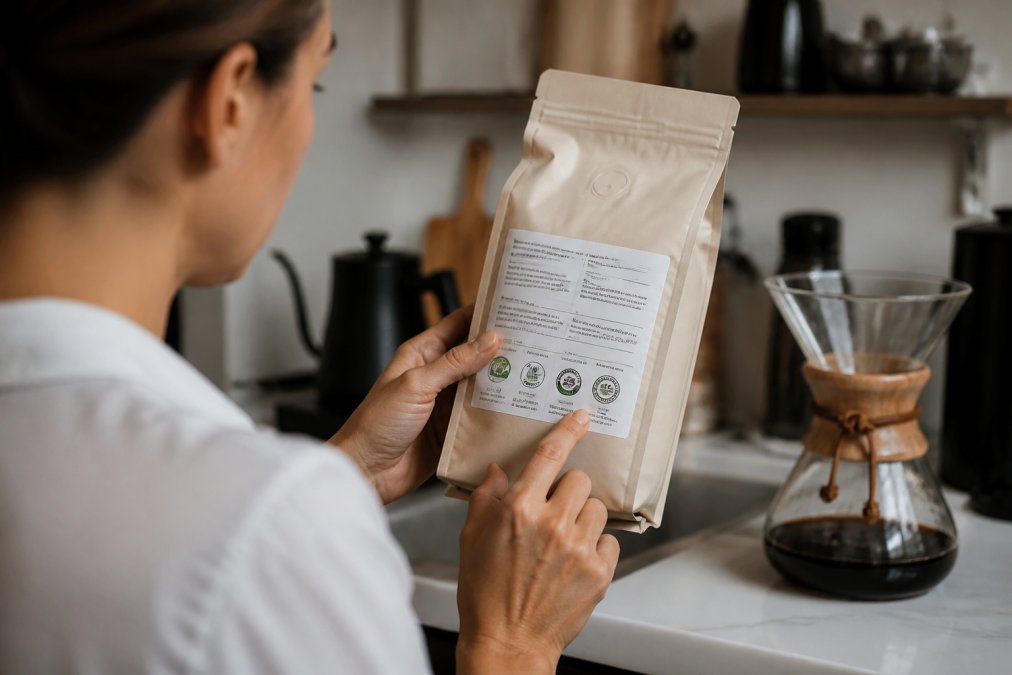
- Check for a certification mark from a recognized third party, not a house-designed logo
- Find the origin down to the region, not just the country
- Look for a named cooperative or farm on the bag or website
- Search the roaster's site for a transparency report with actual prices paid
- Confirm the certification body is real by checking its own website
- Compare the price you're paying against the claimed sourcing story
- Look for harvest and roast dates to confirm the lot is traceable
Step-by-Step Label and Website Audit
Start with the bag. Certifications like Organic and Fairtrade® should carry a recognizable mark and a verifiable license number. Then check the roaster's website for a sourcing or transparency page, and see whether prices paid are stated in numbers or only adjectives.
Greenwashing Detection: The Red Flags Most Shoppers Miss
The harder skill is spotting claims designed to look like certifications without being one. Here are the patterns that show up most on packaging:
- The house-designed seal. A circular logo with a leaf, a mountain, or the word "ethical," with no certifier name or license number. Real certifications carry a verifiable mark and an ID you can look up. If the seal only exists on that roaster's bags, it's a brand asset, not a standard.
- The borrowed adjective. "Sustainably grown," "responsibly sourced," "farm-friendly," "beyond fair trade." These phrases have no legal definition for coffee in the United States, so a roaster can print them without proving anything.
- The vague origin. "A small farm somewhere in the highlands" or "hand-picked by local growers" without a region, cooperative, or farm name. Traceability is the backbone of every real ethical claim; if the origin can't be narrowed below a country, the story can't be checked.
- The certification that doesn't apply. Organic certification covers farming inputs and processing, nothing about farmer pay or labor conditions. A bag can be USDA Organic and still come through a supply chain with no wage protections. Don't let one logo stand in for a claim it doesn't make.
- The expired or mismatched mark. Certification is renewed on a cycle, and a roaster that lost one can leave the logo on old packaging. Cross-check the certifier's public directory against the current product page.
- The price that doesn't add up. If a bag claims a premium paid to farmers but retails at the bottom of the specialty range, the math deserves a second look. Ethical sourcing costs money, and that cost shows up somewhere.
The Ten-Minute Grocery Store Audit
If you're standing in the aisle with your phone, run this sequence:
- Photograph the front and back of the bag. You'll want the certifier marks, the origin line, and any wage or price claims.
- Search the certifier's name plus "verify" or "license lookup." Confirm the mark is current and the roaster is listed.
- Search the roaster's site for "transparency" or "sourcing." Look for named farms and a stated price paid per pound.
- Check the origin against the claim. A single-origin bag should name a region. A blend should still disclose the components.
- Compare the retail price to the story. A high-end ethical claim on a bargain-priced bag is worth questioning.
- Note the harvest date. Fresh, traceable lots usually carry one. A bag with no date and no lot number is harder to verify.
- Decide. Two or more unverifiable claims with no certification and no transparency page is your cue to put the bag down.
The Carbon Footprint of Shipping and Roasting: What Ethical Sourcing Often Misses
The carbon footprint of shipping and roasting is the part of ethical sourcing certification programs largely ignore. A bag can be Fair Trade certified and still travel thousands of miles by air freight, and roasting consumes significant energy.
A few practical things you can actually evaluate:
- Shipping method, since sea freight has a far lower footprint than air freight
- Roast location, because locally roasted beans travel less to reach you
- Roaster transparency about energy use, which is rare but increasingly published
- Packaging, where recyclable or compostable options reduce waste
Frequently Asked Questions
What certifications should I look for to identify ethically sourced coffee?
Start with USDA Organic and Fairtrade® marks, which confirm third-party verification of farming and pricing practices. Rainforest Alliance certification adds environmental and labor standards. No single seal covers everything, so look for a combination. Then check whether the roaster publishes origin details, price premiums paid, and supply chain audit results. A bag with one certification and no further transparency is weaker evidence than a roaster who names the cooperative, the region, and the price paid per pound.
What is the difference between Fair Trade and direct trade coffee?
Fairtrade certification sets a minimum price floor and a social premium paid to cooperatives, verified by an independent body. Direct trade skips the certification body entirely: the roaster negotiates directly with farmers, often paying above Fairtrade rates. The tradeoff is accountability. Fairtrade has third-party verification; direct trade relies on the roaster's own claims. A roaster who publishes farm names, visit records, and per-pound prices gives you something to verify. One who only uses the phrase 'direct trade' gives you marketing copy.
How can I tell if a coffee brand is actually ethical or just greenwashing?
Look for specifics, not adjectives. Ethical roasters name the cooperative, the region, the elevation, and the price paid. They publish transparency reports or impact data. Greenwashers use words like 'sustainable' and 'ethically sourced' without any named farm, certification number, or verifiable figure. Check whether certifications appear as actual logos with license numbers, whether the roaster's website explains its sourcing model in detail, and whether the claims stay consistent across the bag, the site, and third-party reviews.
What does 'ethically sourced' actually mean in the coffee industry?
There is no legal definition, which is why the term is so easily abused. In practice, it means farmers were paid a price that covers production costs and supports a living wage, workers had safe conditions, and environmental practices like shade-grown or organic farming were followed. The strongest proof comes from third-party certification plus roaster transparency reports. Weak proof is a single word on a bag with no named origin, no certification body, and no published pricing data.
How does small-batch roasting impact the ethics of coffee sourcing?
Small-batch roasting does not automatically make coffee ethical, but it often correlates with it. Roasters working in small volumes tend to buy from specific farms or cooperatives rather than commodity blends, which makes traceability easier and supports direct relationships. They also roast to order, which reduces waste and delivers fresher beans. The ethics still depend on what they pay and how they verify it. Ask any small-batch roaster for the farm name and the price paid per pound before assuming the model is ethical.