 ultimate-guide
Benefits of Drinking Loose Leaf Tea: 2026 Guide
Table of Contents
- Why Loose Leaf Tea Beats Tea Bags: The Whole-Leaf Difference
- The Health Benefits of Drinking Loose Leaf Tea
- How to Brew Loose Leaf Tea for Maximum Flavor and Nutrients
- Storing Loose Leaf Tea for Freshness: A Practical Guide
- Cost Per Cup and Environmental Impact: The Numbers Behind Loose Leaf
- Choosing Quality Loose Leaf Tea: What to Look For
- Frequently Asked Questions
Last Updated: September 12, 2026
Why Loose Leaf Tea Beats Tea Bags: The Whole-Leaf Difference
Loose leaf tea is whole or partially broken leaves that unfurl freely in water, while most tea bags hold crushed fragments left over from processing. That difference shapes flavor, aroma, and how many beneficial compounds reach your brew.
This guide from The Gilded Cafe' Co. covers the health case for whole-leaf tea, how to brew it, and the cost and storage math most guides skip.
Fannings, Dust, and What's Actually in a Tea Bag
Most commercial tea bags are filled with fannings and dust: tiny tea particles graded by size, not quality. Both brew fast and dark, releasing tannins quickly, so a bag left too long turns bitter.
Whole leaves steep gradually, releasing flavor in layers rather than all at once. The grade of leaf determines nearly everything about the cup.
Microplastics in Tea Bags: What Recent Testing Shows
Many modern tea bags are sealed with food-grade plastic, and some are made entirely from plastic mesh. Research attention has focused on whether those materials shed particles into hot water. American Chemical Society research on plastic tea bag particles examined this question directly.
The practical takeaway: loose leaf tea brewed in a glass, ceramic, or stainless steel infuser sidesteps the issue entirely.
The Health Benefits of Drinking Loose Leaf Tea
Loose leaf tea supports health through antioxidants, polyphenols, and L-theanine that transfer into your cup during steeping. Whole leaves unfurl over several minutes, releasing more of these compounds than a crushed bag steeped for 30 seconds.
Antioxidants, Polyphenols, and Bioavailability
Polyphenols are plant compounds with antioxidant activity, and catechins are the best-known group in tea. The four major catechins in green tea are epigallocatechin gallate (EGCG), epigallocatechin (EGC), epicatechin gallate (ECG), and epicatechin (EC). EGCG is the most studied and the most abundant in fresh green leaf. Green tea retains more catechins because it undergoes minimal oxidation; black tea is fully oxidized, converting catechins into theaflavins and thearubigins with their own properties. Oolong sits between the two, with a partial oxidation that leaves some catechins intact while developing theaflavins.

Bioavailability is how much of a compound your body can absorb. Catechins are water-soluble, so extraction depends on surface area, time, and temperature. A dust-grade bag releases its compounds in 30 to 60 seconds; whole leaves release more slowly and completely across a 2- to 5-minute steep, and keep releasing on a second or third infusion.
A few practical notes on bioavailability:
- Add citrus. Vitamin C and other acids can improve catechin stability in the gut. A squeeze of lemon in green tea is a common and low-effort way to support absorption.
- Skip the milk in green tea. Casein proteins in dairy can bind polyphenols and reduce how much you absorb. Black tea is more forgiving, but the effect is real.
- Don't over-steep for the sake of strength. Past a certain point you extract more tannins and caffeine, not more catechins, and the cup turns bitter.
- Water quality matters. Chlorine and hard minerals flatten aromatic compounds and can interfere with extraction, which is why filtered water is the baseline.
Heart Health, Cognitive Function, and Immune Support
Tea's polyphenols are studied for cardiovascular support, including inflammation and healthy circulation. Catechins and theaflavins can support endothelial function, healthy LDL cholesterol levels already in the normal range, and normal nitric oxide activity. These are supportive effects, not treatments.
The L-theanine and caffeine pairing is why tea drinkers describe calm focus rather than a jolt. L-theanine, an amino acid found almost exclusively in tea, is associated with increased alpha wave activity on EEG readings, a pattern linked to relaxed alertness. Caffeine blocks adenosine receptors to keep you awake; L-theanine appears to smooth that effect. Whole-leaf tea carries more L-theanine than dust-grade bags because it degrades with age and poor storage.
On cognitive function, the L-theanine and moderate caffeine combination is the most-studied pairing in tea, with research on attention, reaction time, and working memory. The effects are modest and short-term, not a substitute for sleep or medical care.
For immune response, tea contributes antioxidants that support normal immune function as part of a varied diet. The catechins in green tea and the theaflavins in black tea are the compounds most often studied here. A common pattern is that people who drink tea daily also tend to have other healthy habits, so it's hard to isolate tea's contribution. None of this is a substitute for medical care, and no single beverage does the work alone.
Why Whole-Leaf Extraction Changes the Math
The health case for loose leaf isn't just that the leaf is better; it's that the brewing method determines how much of the leaf you actually get. A bag designed to brew in 30 seconds is optimized for speed, not extraction. A whole leaf steeped for three minutes, then re-steeped, gets more from the same plant material.
How to Brew Loose Leaf Tea for Maximum Flavor and Nutrients
Brewing loose leaf tea for maximum flavor and nutrients comes down to three variables: water temperature, leaf quantity, and steeping time.
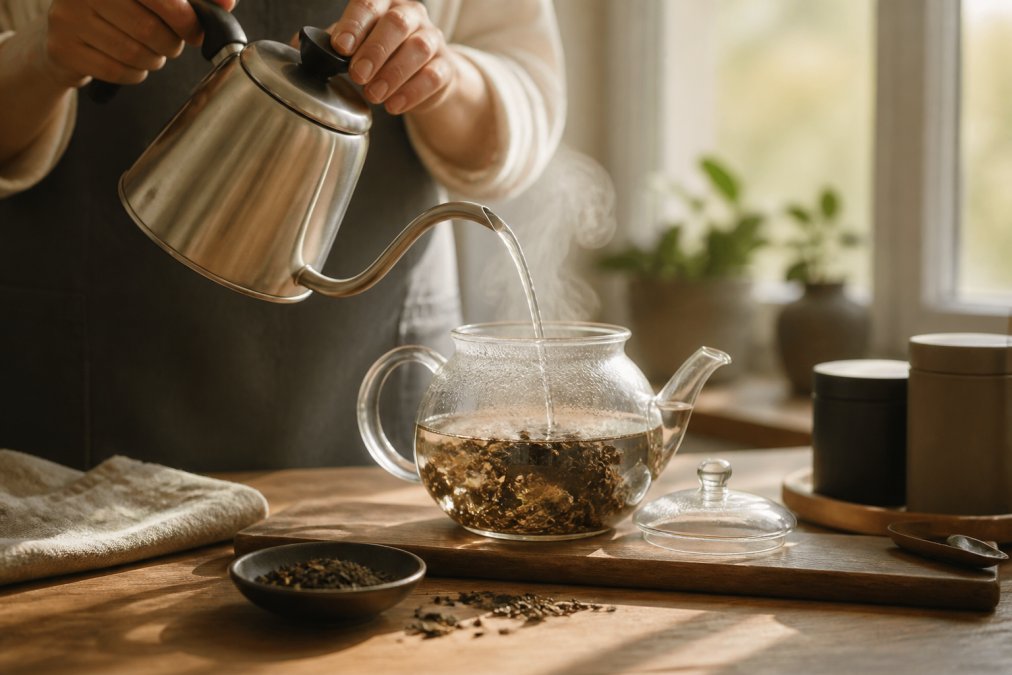
Start with fresh, filtered water; chlorine and hard minerals flatten aromatic compounds. Use roughly one teaspoon of leaf per cup, or 2 to 3 grams, then follow the temperature and timing for your tea type.
Water Temperature and Steeping Times by Tea Type
Getting the temperature wrong is the most common reason a good leaf tastes flat or bitter. Green and white teas scorch easily; black and herbal teas need heat.
Tea Type | Water Temperature | Steeping Time | Notes |
|---|---|---|---|
Green | 160-180°F | 2-3 minutes | Lower heat protects delicate leaves |
White | 175-185°F | 3-5 minutes | Gentle, floral character |
Oolong | 185-205°F | 3-4 minutes | Often re-steeps well |
Black | 200-212°F | 3-5 minutes | Handles full heat |
Herbal | 212°F | 5-7 minutes | Needs a rolling boil |
Most whole-leaf teas re-steep two to three times. Add a little time on each infusion and you'll stretch the same spoonful across an afternoon.
Storing Loose Leaf Tea for Freshness: A Practical Guide
Storing loose leaf tea for freshness means protecting it from four enemies: air, light, heat, and moisture. Tea is hygroscopic, absorbing moisture and odors, which is why a decorative open jar on a sunny shelf is the worst possible home for it.
Keep tea in an airtight, opaque container away from the stove and windows. If you buy in bulk, keep a small amount in your daily tin and store the rest sealed and cool.
- Air: Airtight tins or bags with a real seal, not a folded-over clip
- Light: Opaque containers; glass looks lovely but degrades leaf over time
- Heat: Away from the stove, kettle, and sunny counters
- Moisture: Never store tea in the fridge unless it's vacuum-sealed
- Odor: Keep away from spices and coffee; tea absorbs everything nearby
Buy quantities you'll finish within a few months. Freshness is the whole point of buying whole leaf.
Cost Per Cup and Environmental Impact: The Numbers Behind Loose Leaf
The cost and waste math is where loose leaf wins most decisively.
The Cost-Per-Cup Math
The myth is that loose leaf is expensive. The reality: the sticker price is higher, but the cost per cup is lower because you're buying leaf instead of packaging, and you're re-steeping.
Here's the framework, using round numbers you can plug your own prices into:
- Bagged tea: A typical box of 20 to 40 bags runs roughly $4 to $12. At 20 bags for $6, that's about $0.30 per cup, and you get one cup per bag. Premium bagged tea can run $0.50 to $1.00 per cup.
- Loose leaf: A 2-ounce tin of whole-leaf tea contains roughly 25 to 30 teaspoons, or about 50 to 60 grams. At 2 to 3 grams per 8-ounce cup, that's roughly 20 to 25 cups from a single tin before re-steeping.
- With re-steeping: Most whole-leaf teas re-steep two to three times. That same 2-ounce tin now yields 40 to 75 cups. If the tin costs $22.99, that's roughly $0.31 to $0.57 per cup on the first steep alone, and $0.15 to $0.29 per cup once you count re-steeps.
The comparison isn't $0.30 versus $0.30. It's bagged tea at $0.30 for one cup versus loose leaf at $0.15 to $0.29 for a cup that tastes noticeably better. The upfront premium is packaging and convenience, not leaf.
A few caveats:
- You need an infuser. A basic stainless steel basket runs a few dollars and lasts years. A glass or ceramic teapot costs more but is a one-time purchase.
- You need a scale, ideally. Eyeballing leaf leads to over-brewing, which burns through your tin faster. A $10 to $15 kitchen scale pays for itself in a month.
- Cheap loose leaf can be worse than good bags. Dust-grade "loose leaf" sold in bulk bins is the same fannings and dust that goes into bags, just without the bag. The cost-per-cup advantage only holds if the leaf is actually whole.
Environmental Impact: What You're Actually Avoiding
The sustainability case is straightforward.
- The bag itself. Many modern tea bags are sealed with food-grade plastic, and some are made entirely from plastic mesh (often nylon or PET). Those bags are not compostable and not recyclable in most curbside programs. They go to landfill.
- The wrapper. Individually wrapped bags add a paper or foil wrapper per serving. A box of 40 bags means 40 wrappers, 40 strings, 40 tags, and 40 staples or glued seams.
- The box. A tin of loose leaf replaces an entire box of bags. One tin, one lid, no per-serving packaging.
- The leaf. Spent loose leaves are compostable. They break down in a home compost pile or a municipal program, and they're a decent addition to garden soil.
The net effect: loose leaf shifts packaging from per-serving to per-tin. If you drink a cup a day, that's roughly 365 bags, wrappers, strings, and tags a year replaced by a handful of tins and a reusable infuser.
The Microplastic Angle
This is the part most benefit lists skip entirely. Research attention has focused on whether plastic tea bags shed particles into hot water. American Chemical Society research on plastic tea bag particles examined this question directly. The practical takeaway is simple: if you want to avoid the issue, loose leaf tea brewed in a glass, ceramic, or stainless steel infuser sidesteps it. That's a genuine advantage of whole-leaf brewing that rarely makes the marketing copy, and it's a reason to switch that has nothing to do with flavor.
What This Means for Your Buying Decision
If you drink tea occasionally, the cost and waste difference is small. If you drink it daily, the math compounds: switching from premium bagged tea to whole-leaf loose leaf can cut per-cup cost roughly in half while eliminating hundreds of single-use bags and wrappers a year. The upfront cost is a tin and an infuser; the ongoing cost is lower and the waste stream smaller.
Choosing Quality Loose Leaf Tea: What to Look For
Quality loose leaf tea shows itself before you add water. Whole, unbroken leaves, consistent color, and clear aroma are your first signals. If the leaf crumbles to powder between your fingers, it's a lower grade regardless of the label.
Here's what separates a good tin from a forgettable one:
- Leaf integrity: Whole or large pieces, not dust
- Aroma: Bright and specific to the tea type, not stale or papery
- Origin: Named growing regions signal traceability
- Harvest: Spring-harvest teas tend to carry more nuance
- Packaging: Opaque and airtight, with a real seal
Flavor varies widely by type. A whole-leaf green like ceremonial matcha brings grassy sweetness and umami. A roasted Hojicha delivers toasty, low-caffeine comfort for evenings. A bright Earl Grey with bergamot is a different experience entirely, and a Moroccan Mint green is built for iced tea in summer.

The Gilded Cafe' Co. stocks a small, curated loose-leaf range built around exactly this kind of variety, including a Ceremonial Matcha Green Tea, a Hojicha Roasted Green Tea for evenings, a Moroccan Mint Green Tea that's excellent over ice, and a classic Earl Grey Black Tea. Each is $22.99, and a tin goes considerably further than a box of bags because you're re-steeping whole leaf.

For readers weighing loose leaf tea vs tea bags for the first time, the difference is real but requires a little more attention. A simple infuser and a two-minute habit change is the whole learning curve.
Frequently Asked Questions
Are loose leaf teas healthier than tea bags?
Loose leaf tea generally retains more antioxidants because whole leaves have greater surface area for steeping and are less processed than the fannings and dust in most bags. A 2019 study in the Journal of Food Science found loose leaf green tea had higher levels of catechins than bagged versions. However, the biggest health difference comes from what you avoid: many commercial tea bags are sealed with polypropylene plastic, which can release microplastics into hot water.
Does loose leaf tea contain more antioxidants than bagged tea?
Yes, typically. Whole-leaf tea contains intact polyphenols and catechins that degrade during the crushing and sifting process used to make bagged tea. Because loose leaves unfurl fully during steeping, more of these compounds transfer to your cup. The difference is most pronounced in green and white teas, where processing has a bigger impact on nutrient density. Using proper brewing temperature (around 175°F for green tea) preserves more of these compounds than boiling water.
Is it worth switching from tea bags to loose leaf tea?
For most daily tea drinkers, yes. Loose leaf tea costs more per package but often less per cup because you can re-steep leaves two to three times. The flavor difference is significant: whole leaves produce a fuller, more complex infusion with distinct sensory notes that bagged tea cannot match. If you drink tea daily, the switch pays for itself within a month, and you avoid the microplastic exposure from plastic-sealed bags.
What should I look for when buying premium loose leaf tea?
Check three things: origin (single-region teas list the specific garden or region), harvest date (fresher is better, ideally within 12 months), and leaf appearance (whole, unbroken leaves signal quality). Avoid packages with no harvest information or leaves that look like dust. Brands like The Gilded Cafe' Co. offer single-origin options such as Ceremonial Matcha Green Tea from Shizuoka, Japan, which includes specific sourcing details on the label.