 ultimate-guide
Best Coffee Brewing Methods for Beginners
Table of Contents
- Best Coffee Brewing Methods for Beginners: A Simple Comparison
- Why Your Brewing Method Changes the Flavor
- Coffee Brewing Ratios for Beginners
- The Pour-Over Method: Clean and Bright Cups
- The French Press: Rich and Full-Bodied Coffee
- French Press vs Pour Over for Beginners: Which to Pick?
- Easy Alternatives: Cold Brew, Drip Machines, and Single-Serve
- Coffee Grind Size Chart for Beginners
- Frequently Asked Questions
Last Updated: September 5, 2026
Best Coffee Brewing Methods for Beginners: A Simple Comparison
Walking into the coffee aisle or scrolling through brewing gear online can feel overwhelming when you are just starting out. The best coffee brewing methods for beginners are the ones that fit your daily routine, your taste preferences, and your budget without requiring a chemistry degree to operate. At The Gilded Cafe' Co., we believe that great coffee starts with understanding a few simple principles, and this guide breaks down the most popular techniques so you can find your perfect match.
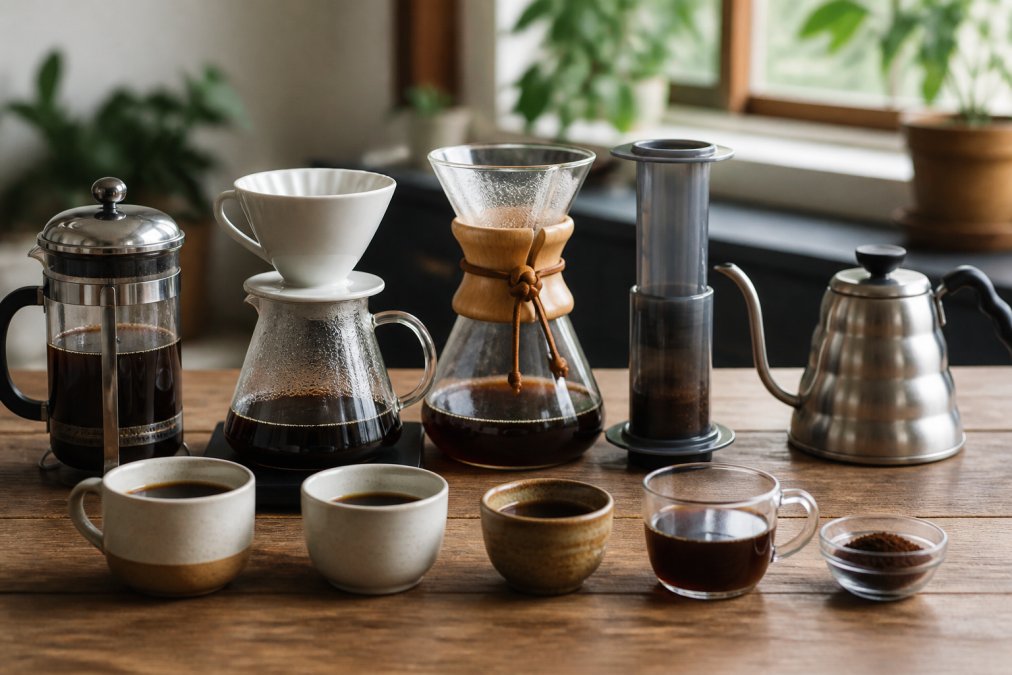
Coffee brewing is the process of extracting flavor from roasted coffee beans using water. The method you choose controls how much flavor, oil, and body ends up in your cup, which is why the same bag of beans can taste dramatically different depending on how you brew it. Below, we will walk through the most beginner-friendly methods, explain what makes each one unique, and help you pick the right starting point for your home setup.
Why Your Brewing Method Changes the Flavor
The equipment you use directly influences extraction, which is the process of dissolving the desirable compounds from coffee grounds into water. Different methods rely on different brewing principles: immersion brewing soaks the grounds fully in water, while gravity-based methods push water through a bed of coffee. This single difference changes everything about the final cup.
A French press uses full-immersion brewing, which means the coffee stays in contact with water for the entire brew time. This extracts more natural oils and fine particles, producing a heavier body and a richer, more textured mouthfeel. Pour-over methods, on the other hand, use gravity to pull water through the grounds once, and the paper filter traps most of the oils, resulting in a cleaner cup with higher clarity and brighter acidity.
Water temperature also plays a major role. Water that is too hot can scorch the grounds and create bitterness, while water that is too cool will under-extract and leave your coffee tasting sour and weak. Most experts recommend water just off the boil, around 195 to 205 degrees Fahrenheit, for optimal extraction. National Coffee Association brewing guidelines The grind size must match your method: finer grounds extract faster, while coarser grounds need more time to release their flavor.
Coffee Brewing Ratios for Beginners
Getting the coffee-to-water ratio right is the single fastest way to improve your home brew. The golden standard used by most coffee professionals is 1:16, which means one gram of coffee for every sixteen grams of water. This ratio produces a balanced cup that highlights the beans' natural sweetness without tasting thin or overly strong.
For a standard 12-ounce cup, that translates to roughly 21 grams of coffee and 340 grams of water. If you prefer a bolder, more intense cup, try a 1:14 ratio. If you enjoy lighter, more delicate coffee, a 1:18 ratio will suit you better. A simple digital kitchen scale removes all the guesswork and gives you consistent results every single morning.
Brewing Method | Coffee-to-Water Ratio | Brew Time | Grind Size |
|---|---|---|---|
Pour-over | 1:16 | 2.5 to 3.5 minutes | Medium-fine |
French Press | 1:15 | 4 minutes | Coarse |
1:8 | 12 to 24 hours | Extra-coarse | |
Drip Machine | 1:16 | 5 to 6 minutes | Medium |
Single-Serve | Pre-measured | 1 minute | Pre-ground |
The Pour-Over Method: Clean and Bright Cups
The pour-over method is a gravity-based brewing technique where hot water is poured in a slow, controlled spiral over coffee grounds held in a filter. This method is prized for producing a clean, bright, and nuanced cup that highlights the subtle flavor notes of single-origin beans, like the dried orange and berry tones found in our Colombian single origin.

To brew pour-over coffee at home, you will need a dripper, paper filters, a gooseneck kettle, and freshly ground coffee. Heat your water to just off the boil, place a filter in the dripper, and rinse it with hot water to remove any papery taste. Add your ground coffee and give it a gentle shake to level the bed.
The first pour is called the bloom. Pour just enough water to saturate the grounds, about twice the weight of the coffee, and let it sit for 30 to 45 seconds. This releases trapped carbon dioxide from freshly roasted beans and allows for better extraction. After the bloom, continue pouring in slow, circular motions, working from the center outward. The total brew time should land between 2.5 and 3.5 minutes for a single cup.
The main drawback is that pour-over requires more attention and a steady hand than other methods. You are controlling the pour, the timing, and the water temperature all at once. That said, the payoff is a level of clarity and sweetness that is hard to achieve with any other method. Specialty Coffee Association brew control chart
The French Press: Rich and Full-Bodied Coffee
The French press is the most forgiving and accessible entry point into manual brewing. This immersion brewing method steeps coarsely ground coffee in hot water for several minutes before a metal mesh plunger separates the grounds from the liquid. Because the metal mesh allows fine particles and natural oils to pass through, the resulting cup has a full body, a velvety mouthfeel, and a rich, strong flavor profile.
Start by adding coarsely ground coffee to the glass carafe, then pour hot water over the grounds. Give the mixture a gentle stir to ensure all the coffee is saturated, then place the lid on top with the plunger pulled all the way up. Let it steep for four minutes, which is the sweet spot for a balanced extraction.
After four minutes, press the plunger down slowly and steadily. Pressing too fast can agitate the grounds and make your coffee bitter and gritty. Pour the coffee immediately into your mug, because leaving it sitting on the grounds will continue the extraction process and turn your cup bitter.
French press coffee is wonderfully forgiving. You do not need a fancy kettle or a precise pouring technique, just a timer and a coarse grind. The trade-off is sediment at the bottom of your cup and a heavier mouthfeel that some drinkers find too thick. If you love bold, chocolatey flavors like the dark chocolate and molasses notes in our Bali single origin, this method will serve you well.
French Press vs Pour Over for Beginners: Which to Pick?
Choosing between the french press and the pour-over method comes down to what you value most in your morning cup. French press brewing is the better choice for beginners who want rich, full-bodied coffee with minimal equipment and a forgiving process. Pour-over is the better choice if you prioritize clarity, brightness, and the ability to taste distinct flavor notes, and you do not mind a bit more hands-on attention.
The french press requires only a carafe, a plunger, and a coarse grind, making it the lower-cost and lower-effort option. It produces a heavier cup with more natural oils and a thicker texture. The pour-over method requires a dripper, filters, and a gooseneck kettle for best results, and it rewards careful technique with a cleaner, more delicate cup.
Consider your daily routine. If you want to set a timer and walk away while your coffee steeps, the french press is your method. If you enjoy a mindful morning ritual where you control every variable, pour-over will feel more rewarding. Many home brewers eventually own both, using the french press for busy weekdays and the pour-over for slow weekend mornings.
Feature | French Press | Pour-Over |
|---|---|---|
Body | Full and heavy | Light and clean |
Flavor Clarity | Lower due to oils | High and bright |
Difficulty | Very easy | Moderate |
Equipment Cost | Lower | Higher |
Brew Time | 4 minutes | 3 to 4 minutes |
Easy Alternatives: Cold Brew, Drip Machines, and Single-Serve
Not every morning calls for a manual brewing ritual. Three other methods deserve a place in your rotation because they deliver excellent results with almost no effort.
Cold brew is the most forgiving brewing method in existence. You combine coarsely ground coffee with cold water at a ratio of roughly 1:8, let it steep in the refrigerator for 12 to 24 hours, and then strain out the grounds. The long, cold extraction produces a smooth, low-acidity concentrate that you can dilute with water or milk. It is perfect for warm months and for anyone who finds hot coffee too acidic. Our Cold Brew Coffee blend, with its smooth chocolate, toffee, and floral tones, is roasted specifically for this method.
Automatic drip coffee makers are the classic weekday workhorse. They handle the water heating, the pouring, and the timing for you, delivering a consistent pot of coffee with the press of a button. The quality of the final cup depends heavily on the quality of your beans and the cleanliness of your machine. Use a medium grind and the same 1:16 ratio you would use for pour-over, and your drip machine will produce a solid, dependable cup.
Single-serve capsules offer the ultimate in convenience and consistency. Each capsule is pre-measured and sealed, so you never have to think about grind size or ratios. Our 12 Pack Single Serve Coffee Capsules and 60 Pack Single Serve Coffee Capsules use an improved filter design that absorbs more grounds for a lively cup without slowing down the brew time. This is the easiest possible entry point for someone who wants better coffee than instant but does not want to buy any brewing equipment.

Coffee Grind Size Chart for Beginners
Grind size is the variable beginners overlook most often, and it is the most common reason home coffee tastes bitter or sour. The rule is simple: the faster the water passes through the coffee, the finer the grind should be. If your coffee tastes bitter, your grind is likely too fine and the water is over-extracting. If it tastes sour or weak, your grind is too coarse and the water is under-extracting.
Brewing Method | Grind Size | Texture Comparison |
|---|---|---|
Cold Brew | Extra-coarse | Rock salt |
French Press | Coarse | Sea salt |
Drip Machine | Medium | Sand |
Pour-over | Medium-fine | Fine sand |
Single-Serve | Fine | Table salt |
A burr grinder is worth the investment because it produces uniform particles, which leads to even extraction. Blade grinders chop the beans unevenly, creating both fine dust and large chunks that extract at different speeds and muddy the flavor. Serious Eats guide to coffee grinders Freshly roasted beans ground right before brewing also make a noticeable difference, as pre-ground coffee loses its volatile aromatics within minutes.
The best brewing method is the one you will actually use every day. Start with a french press for its simplicity and rich flavor, or grab a pour-over setup if you love the ritual and want brighter, cleaner cups. Whichever path you choose, start with freshly roasted, small-batch beans like the ones we roast at The Gilded Cafe' Co., and use a burr grinder to keep your grind consistent. If you are not sure where to begin, our Best Sellers Sample Pack lets you taste six different roasts and find the flavor profile that makes your morning ritual worth savoring.

Choosing your first brewing method does not have to be complicated. The The Gilded Cafe' Co. team roasts small batches of specialty beans and delivers them fresh to your door, so you can focus on mastering your technique rather than hunting for quality ingredients. Explore our single-origin favorites and house blends, pair them with our White Glossy Ceramic Mug for your daily pour-over, and start brewing coffee that tastes like it came from a caf. Get started with The Gilded Cafe' Co. and turn your home brewing into a ritual you look forward to every morning.
Frequently Asked Questions
What is the easiest coffee brewing method for a beginner?
For most beginners, a standard automatic drip machine or a French press offers the simplest path to good coffee. Drip machines handle the water temperature and timing for you. The French press requires only a coarse grind, hot water, and a four-minute wait before pressing the plunger. Both methods forgive small mistakes in measuring, making them ideal starting points before you invest in more precise pour-over gear.
What is the best coffee-to-water ratio for beginners?
Start with a 1:16 ratio, meaning 1 gram of coffee for every 16 grams (or milliliters) of water. For a standard 12-ounce cup, that equals about 21 grams of coffee and 340 grams of water. This ratio produces a balanced cup that is neither too strong nor too weak. Adjust slightly to taste after your first brew.
Is a French press or pour-over better for beginners?
The French press is generally more forgiving for beginners. It requires a coarse grind and relies on immersion brewing, so slight timing errors have less impact on flavor. Pour-over methods demand more technique, including a steady hand for pouring and a consistent water flow. If you want a fuller-bodied cup with less fuss, choose the French press. If you prefer a clean, bright cup and are willing to practice your pour, choose the pour-over.
What grind size should I use for my coffee brewer?
Match your grind size to your brew time. For a French press, use a coarse grind that looks like breadcrumbs. For pour-over methods like a V60, use a medium-fine grind similar to table salt. For automatic drip machines, a medium grind works best. If your coffee tastes bitter, your grind is too fine. If it tastes sour or weak, your grind is too coarse.
How does the coffee brewing method affect the flavor of the beans?
Each method extracts flavors differently. Immersion brewing, like the French press, keeps grounds fully submerged, producing a heavier body with more natural oils and sediment. Gravity-based methods, like pour-over, push water through a paper filter, resulting in a cleaner, brighter cup with more clarity and less bitterness. Your choice of method highlights different aspects of the same bean.
Frequently Asked Questions
What is the easiest coffee brewing method for a beginner?
For most beginners, a standard automatic drip machine or a French press offers the simplest path to good coffee. Drip machines handle the water temperature and timing for you. The French press requires only a coarse grind, hot water, and a four-minute wait before pressing the plunger. Both methods forgive small mistakes in measuring, making them ideal starting points before you invest in more precise pour-over gear.
What is the best coffee-to-water ratio for beginners?
Start with a 1:16 ratio, meaning 1 gram of coffee for every 16 grams (or milliliters) of water. For a standard 12-ounce cup, that equals about 21 grams of coffee and 340 grams of water. This ratio produces a balanced cup that is neither too strong nor too weak. Adjust slightly to taste after your first brew.
Is a French press or pour-over better for beginners?
The French press is generally more forgiving for beginners. It requires a coarse grind and relies on immersion brewing, so slight timing errors have less impact on flavor. Pour-over methods demand more technique, including a steady hand for pouring and a consistent water flow. If you want a fuller-bodied cup with less fuss, choose the French press. If you prefer a clean, bright cup and are willing to practice your pour, choose the pour-over.
What grind size should I use for my coffee brewer?
Match your grind size to your brew time. For a French press, use a coarse grind that looks like breadcrumbs. For pour-over methods like a V60, use a medium-fine grind similar to table salt. For automatic drip machines, a medium grind works best. If your coffee tastes bitter, your grind is too fine. If it tastes sour or weak, your grind is too coarse.
How does the coffee brewing method affect the flavor of the beans?
Each method extracts flavors differently. Immersion brewing, like the French press, keeps grounds fully submerged, producing a heavier body with more natural oils and sediment. Gravity-based methods, like pour-over, push water through a paper filter, resulting in a cleaner, brighter cup with more clarity and less bitterness. Your choice of method highlights different aspects of the same bean.