 how-to
Best Loose Leaf Tea Brewing Methods: A 2026 Guide
Table of Contents
- Loose Leaf Tea vs Tea Bags: Why the Difference Matters
- How to Measure Loose Leaf Tea for Any Cup Size
- The Tea Brewing Temperature Chart You Need
- How Long to Steep Green Tea (and Every Other Type)
- The Best Loose Leaf Tea Brewing Methods for Every Ritual
- Common Mistakes to Avoid When Brewing Loose Leaf Tea
- Frequently Asked Questions
Last Updated: September 16, 2026
Loose Leaf Tea vs Tea Bags: Why the Difference Matters
Walk down any grocery aisle and you'll see shelves of bagged tea promising convenience. But the best loose leaf tea brewing methods start with understanding why whole leaves behave differently than the dust and fannings packed into most bags. This guide from The Gilded Cafe' Co. breaks down exactly how to brew loose leaf tea well, from measuring to steeping.
Loose leaf tea is whole or partially broken tea leaves that steep freely in water rather than being confined to a paper pouch. That freedom lets leaves expand fully and release more aroma and flavor compounds. Bagged tea typically contains smaller particles that steep fast but taste flatter.
The trade-off is real: loose leaf asks for a bit more attention. In practice, that attention takes seconds, not minutes, once you know your numbers.
How to Measure Loose Leaf Tea for Any Cup Size
The most common mistake is eyeballing a "pinch" and getting a weak or bitter cup. A kitchen scale removes the guesswork entirely.
Most loose leaf teas call for 2.5 grams per 12 ounces of water. For powdered teas like matcha or hojicha, that changes: matcha uses about 1 gram per 8 ounces, while hojicha calls for 3 grams per 8 ounces.
Tea Type | Amount | Water | Notes |
|---|---|---|---|
Black tea (Earl Grey, English Breakfast) | 2.5 g per 12 oz | 195°F | 5-10 min steep |
Green tea (Jasmine, Moroccan Mint) | 2.5 g per 12 oz | 175-185°F | 2-6 min steep |
Matcha powder | 1 g per 8 oz | 175°F | Whisk, don't steep |
Hojicha powder | 3 g per 8 oz | 175°F | Whisk or latte |
Rooibos (Apple Cider) | 2.5 g per 12 oz | 212°F | 4-6 min steep |
No scale on hand? A level teaspoon of most loose leaf teas lands close to 2 to 3 grams. It's an approximation, but a workable one.

The Tea Brewing Temperature Chart You Need
Water temperature decides whether your tea tastes sweet or scorched. Green teas burn easily above 185°F, while black teas and herbal blends need near-boiling water to open up.
Here's the working range for each category:
- Green tea: 175-185°F. Above this, bitterness takes over.
- Black tea: 195°F. Hot enough for malt and citrus notes to develop.
- Herbal and rooibos: 212°F. These need full boil to extract flavor.
- Matcha and hojicha powder: 175°F. Whisked, not steeped.
No thermometer? Boil water, then let it sit. A few minutes off the boil gets you into green tea range; a shorter pause works for black tea.

How Long to Steep Green Tea (and Every Other Type)
Steeping time is where most cups go wrong, and green tea is the most unforgiving. Green tea should steep for 2 to 6 minutes depending on the specific leaf, with delicate varieties like Moroccan Mint finishing closer to 2-3 minutes and jasmine landing around 4-6.
Black teas are more forgiving. Earl Grey and English Breakfast both want 5-10 minutes, while Masala Chai sits at 5-7. Rooibos blends like Apple Cider need 4-6 minutes at full boil.

The rule that matters: taste at the short end of the range first. You can always steep longer, but you can't un-bitter a cup.
The Best Loose Leaf Tea Brewing Methods for Every Ritual
Different moments call for different equipment. Here's how the main methods compare, and which teas suit each one.
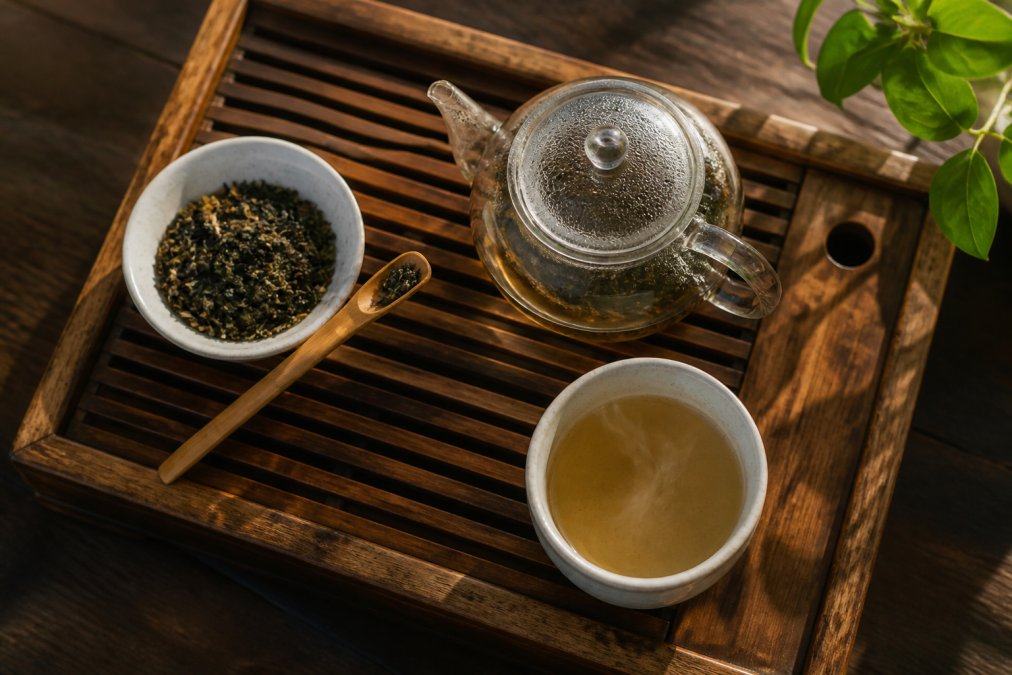
Western-style steeping is the simplest: an infuser basket in your mug, tea measured in, water poured over, timer set. It suits black teas and flavored blends where you want one solid cup without fuss.
Gongfu-style brewing uses a small vessel and repeated short steeps, building flavor across several pours. It rewards whole-leaf green and oolong teas that hold up to multiple infusions, like jasmine.
Whisking applies only to powdered teas. Matcha and hojicha are sifted, combined with a small amount of hot water, and whisked in a zigzag motion until frothy. No steeping involved.
Cold brewing means steeping leaves in cold water for hours rather than minutes. It produces a smoother, less bitter cup, and works especially well for fruity black teas like Peach Paradise or Mango Treat served over ice.
Method | Best For | Effort | Time |
|---|---|---|---|
Western steeping | Black and flavored teas | Low | 5-10 min |
Gongfu-style | Whole-leaf green and oolong | Medium | Multiple short steeps |
Whisking | Matcha and hojicha powder | Medium | Under 2 min |
Cold brewing | Iced tea, fruity blends | Low | Several hours |
Common Mistakes to Avoid When Brewing Loose Leaf Tea
Even experienced brewers slip on the same handful of errors. Here's what to watch for.
Using boiling water on green tea. This is the single most common way to ruin a delicate leaf. Green teas want 175-185°F, and pouring straight from a rolling boil scalds them into bitterness.
Under-measuring the leaves. A weak cup usually isn't a bad tea, it's too little leaf. If your tea tastes thin, add half a gram before you blame the blend.
Steeping the same leaves forever without adjusting. Re-steeping is fine, but each round needs a little more time than the last. Reusing leaves at the original steep time gives you flavored water.
Ignoring storage. Loose leaf tea fades with air and light exposure. Keep it sealed and away from the stove.
The gap between a mediocre cup and a memorable one comes down to three numbers: temperature, amount, and time. Most people never learn them, which is why so much tea gets wasted on guesswork.
At The Gilded Cafe' Co., we source small-batch loose leaf teas from renowned growing regions so the leaves themselves give you a head start. Our Ceremonial Matcha Green Tea is stone-milled for a smooth, buttery whisk, our Earl Grey Black Tea pairs premium Ceylon with real bergamot oil, and every blend ships direct to your door with brewing guidance built around these exact measurements. Get started with The Gilded Cafe' Co. and turn your daily cup into the ritual it deserves.
Frequently Asked Questions
What is the best way to brew loose leaf tea without an infuser?
You can brew loose leaf tea without an infuser using the traditional method: add leaves directly to a teapot or cup, pour hot water over them, and steep for the recommended time. When ready, pour the tea through a fine mesh strainer into another cup to catch the leaves. This method works well for large-leaf teas like Earl Grey Black Tea. Alternatively, you can use a French press, which acts as a built-in strainer.
How much loose leaf tea should I use per cup?
The general rule is 2.5 grams (about 1 teaspoon) of loose leaf tea per 12 ounces of water. For lighter teas like Jasmine Green Tea, you might prefer 2.5 grams per 12 ounces. For bold black teas like Masala Chai, the same measurement works well. Adjust based on your taste preferences. Using a small kitchen scale ensures consistency, but a measuring spoon is a fine starting point.
Does water temperature matter for loose leaf tea?
Yes, water temperature significantly affects flavor. Green and white teas brew best at 175°F to 185°F to avoid bitterness. Black and oolong teas need hotter water, around 195°F to 212°F, to fully extract their rich flavors. For example, our Hojicha Roasted Green Tea recommends 175°F, while Earl Grey Black Tea calls for 195°F. Using the right temperature brings out the best in every leaf.
How long should you steep different types of loose leaf tea?
Steeping times vary by tea type. Green teas like Moroccan Mint Green Tea steep for 2 to 3 minutes, while Jasmine Green Tea recommends 4 to 6 minutes. Black teas such as English Breakfast Black Tea need 5 to 7 minutes. Herbal blends like Apple Cider Rooibos Tea steep for 4 to 6 minutes. Always check the specific instructions on your tea's packaging for the best results.