 how-to
How to Choose a Coffee Roast Profile: 2026 Guide
Table of Contents
- Roast Profile Basics: Degree, Curve, and Development
- Light vs Dark Roast Flavor Profile: Acidity, Body, and Mouthfeel
- How to Identify Coffee Roast Notes Before You Buy
- The Best Coffee Roast for Pour Over and Other Brew Methods
- Matching Roast Profile to Bean Density, Origin, and Processing
- Troubleshooting Roast Profiles and Evaluating Flavor at Home
- Frequently Asked Questions
Last Updated: September 20, 2026
Roast Profile Basics: Degree, Curve, and Development
Learning how to choose coffee roast profile starts with understanding three things: how dark the beans get, how the roast progresses over time, and how long the beans develop after first crack. A coffee roast profile is the record of time and temperature a roaster applies to green coffee to reach a target flavor. This guide from The Gilded Cafe' Co. breaks down what each part controls so you can pick beans with confidence.
Roast Degree on the Agtron Scale
The Agtron scale is a numeric system that grades roast color from light to dark. Roasters use it to keep batches consistent.
Here is how the ranges break down:
- Light roast: high Agtron score, bright and acidic
- Medium roast: mid-range score, balanced and sweet
- Dark roast: low Agtron score, smoky and bold
Why Roast Curve and Rate of Rise Matter
A steady rate of rise prevents flavor problems. If the bean temperature stalls, the coffee tastes flat and bready. If it spikes, you scorch the outside before the inside cooks.

The time between them shapes acidity, body, and sweetness.
Light vs Dark Roast Flavor Profile: Acidity, Body, and Mouthfeel
Light roasts taste bright, fruity, and tea-like, while dark roasts taste bold, smoky, and low in acid. The difference comes down to how far the roast pushes past first crack.
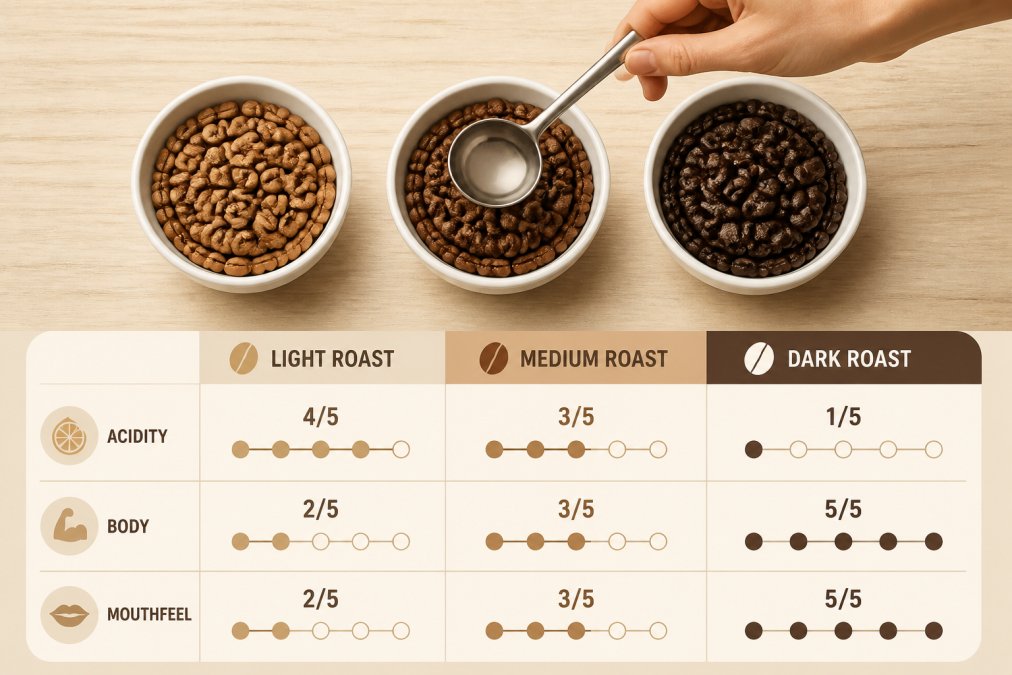
Here is the trade-off in plain terms:
- Light roast: higher acidity, lighter body, clearer origin flavors
- Medium roast: balanced acidity, rounder body, caramel sweetness
- Dark roast: low acidity, heavy body, roasted and smoky notes
How to Identify Coffee Roast Notes Before You Buy
You can predict most of a coffee's flavor from the label alone. Learning how to identify coffee roast notes means reading four things: roast level, origin, processing method, and tasting notes.

A quick label-reading checklist:
- Roast level listed (light, medium, dark)
- Origin or region named
- Processing method stated
- Roast date printed, not just a best-by date
- Tasting notes that match your preferences
The Best Coffee Roast for Pour Over and Other Brew Methods
The best coffee roast for pour over is a light or medium roast, because those brewing methods highlight acidity and delicate flavor. Dark roasts work better in methods that mute brightness, like French press or espresso.
Here is how roast level pairs with common brewers:
Brew Method | Best Roast Level | Why It Works |
|---|---|---|
Pour over | Light to medium | Shows off acidity and clarity |
Drip | Medium | Balanced and forgiving |
French press | Medium to dark | Body and richness shine |
Espresso | Medium to dark | Cuts through milk and pressure |
Cold brew | Dark | Bold flavor survives long steep |
Moka pot | Medium to dark | Handles high heat well |
Matching Roast Profile to Bean Density, Origin, and Processing
Dense beans from high altitudes handle light roasts well. Softer, lower-grown beans do better at medium or dark. This is the part most roast guides skip, and it is the single biggest lever a home roaster can pull.
Reading Density Before You Roast
You can estimate density without a lab:
- Screen size: Larger beans (17-18 screen and up) are usually denser than small beans from the same lot.
- Weight in the hand: A 16 oz bag of dense beans feels heavier for its volume than the same weight of soft beans.
- Moisture: Fresh-crop green coffee typically holds 10-12% moisture by weight. Older or poorly stored green coffee drops below that and roasts faster and flatter.
- Elevation on the label: Beans grown above roughly 1,200 meters are almost always denser than beans grown below 900 meters.
If you have a scale and a graduated cylinder, you can calculate density directly: weight in grams divided by volume in milliliters. Dense arabica typically lands around 0.70-0.75 g/mL; softer beans fall closer to 0.60-0.65 g/mL.
How Density Changes the Roast Curve
Dense beans need a different curve, not just a different drop temperature:
- More energy up front. Dense beans absorb heat slowly, so a higher charge temperature and a stronger early rate of rise get them to first crack in a reasonable time. Starve them of heat and the roast stalls.
- Longer development after first crack. Dense beans can take 20-25% of total roast time in development without going flat. Soft beans often taste baked past 15-18%.
- Higher first-crack temperature. Dense beans commonly crack a few degrees higher than soft beans, so do not assume a missed crack means a stalled roast.
Origin and Processing as Density Signals
Origin is a rough proxy for density, and processing shifts it further:
- African coffees (Kenya, Ethiopia): often high-grown and dense, floral and fruity, best as light roasts with a long development phase.
- Central American coffees (Guatemala, Costa Rica): balanced and sweet, flexible across roast levels, usually medium density.
- South American coffees (Brazil, Colombia): nutty and chocolatey; Brazilian beans in particular are often lower-grown and softer, so they do better at medium.
- Indonesian coffees (Sumatra, Sulawesi): earthy and heavy, frequently processed wet-hulled, which lowers density and suits darker roasts.
A Practical Adjustment Rule
When you switch beans, change one variable at a time. If the new bean is denser than your last one, raise charge temperature slightly and extend development by 30-60 seconds. If it is softer, do the opposite. Keep notes on bean, density estimate, charge temp, first-crack time, and total time. After a handful of roasts you will have a personal density-to-curve map that no generic guide can give you.
green coffee moisture and density measurement guidance
Troubleshooting Roast Profiles and Evaluating Flavor at Home
If your coffee tastes flat, baked, or bitter, the roast profile is often the cause. You can spot most problems by taste alone, even without roasting equipment. The trick is to map each defect to the phase of the roast that produced it, then change one variable on the next batch.
Mapping Taste Defects to Roast Phases
Roasting has three rough phases: drying (start to roughly 300°F bean temperature), Maillard and browning (300°F to first crack), and development (first crack to drop). Each phase produces a distinct defect when it goes wrong.
- Flat and bready: the roast stalled during drying or early browning. Rate of rise flattened before first crack, so sugars never developed. Fix: raise charge temperature or increase early heat so the bean temperature climbs steadily into first crack.
- Ashy and bitter: roasted too dark, past the start of second crack. Fix: drop 10-15°F earlier, or shorten development by 30 seconds.
- Sour and thin: underdeveloped. First crack arrived but development was too short, leaving grassy acids intact. Fix: extend development time to 20-25% of total roast time.
- Harsh and drying: over-extracted in the cup, not necessarily a roast defect. Fix: grind coarser or shorten brew time before blaming the roast.
- Baked and papery: a long, slow roast with a low rate of rise throughout. Fix: increase heat earlier and shorten total time.
- Scorched or tipped: too much heat at the start. Fix: lower charge temperature and ease the first minute.
A Repeatable Home Cupping Protocol
Sensory evaluation is the skill that ties it together. Cupping is a standard method for tasting coffee where you slurp from a spoon to spread the liquid across your palate. It helps you separate roast flavor from origin flavor.
- Dose: 8.25 grams of coffee per 5 fluid ounces (about 150 ml) of water. Keep this ratio fixed.
- Grind: coarse, roughly the size of sea salt. Grind fresh for each cup.
- Water: just off boil, around 200-205°F. Pour over the grounds and start a timer.
- Crust: at 4 minutes, break the crust with a spoon and skim the foam.
- Taste: at 8-10 minutes, when the cup is cool enough to slurp, take notes.
- Score: rate each attribute on a simple 1-5 scale.
What to Score
Score these attributes, not just "good" or "bad":
- Acidity: bright and juicy (high) versus flat and dull (low).
- Body: thin and tea-like versus syrupy and coating.
- Sweetness: caramel or fruit sweetness versus none.
- Aftertaste: clean and lingering versus harsh or ashy.
- Balance: do the attributes support each other, or does one dominate?
Compare two roasts side by side using the same protocol. Slurping feels odd the first time, but it aerates the coffee and makes differences easier to taste. Write down the score for each attribute, then match the low scores back to the roast-phase table above. That is how you turn a vague "this tastes off" into a specific adjustment for your next batch.
Frequently Asked Questions
What is the 15-15-15 rule for coffee?
The 15-15-15 rule is a home-brewing guideline: 15 grams of coffee, 15 times that weight in water (225 grams), brewed for 15 minutes with a French press. It produces a balanced, full-immersion cup that works well with medium and dark roast profiles. For lighter roasts, many brewers adjust the ratio slightly to 1:16 to tame the brighter acidity. Treat it as a starting point, then tweak grind size and water temperature to match your coffee roast profile.
How does roast profile affect caffeine content?
Roast profile changes caffeine content only slightly. A light roast retains marginally more caffeine by weight because beans lose mass during roasting, but the difference is small. What changes dramatically is flavor: darker roasts develop smoky, chocolatey notes and lower acidity, while lighter roasts keep fruity, floral origin characteristics. If you are choosing a coffee roast profile for caffeine, focus on dose and brewing method instead. A 12-ounce drip coffee from a French Roast and one from a Blonde Blend land within roughly the same caffeine range.
Which coffee roast is easier on the stomach?
Dark roasts are often reported as easier on the stomach because extended roasting reduces some of the acids found in green coffee. If you are sensitive to acidity, a dark roast like French Roast, with its low acidity and smooth finish, tends to be a gentler choice. Medium roasts can also work well. The bigger factor is usually brew strength and whether you drink coffee on an empty stomach. Try a darker coffee roast profile and see how your body responds.
What is the difference between roast level and roast profile?
Roast level describes the final color and degree of roast, such as light, medium, or dark. Roast profile is the full plan a roaster follows to get there: charge temperature, bean temperature targets, rate of rise, first crack timing, development time, and cooling phase. Two coffees can finish at the same roast level but taste completely different because their profiles differ. When you choose a coffee roast profile, you are really choosing the roaster's decisions about heat application, airflow, and timing.