 how-to
How to Store Coffee Beans Properly: A 2026 Guide
Table of Contents
- Why Proper Coffee Bean Storage Matters
- The Four Enemies of Freshness: Heat, Light, Moisture, and Air
- How to Store Coffee Beans Properly: A Step-by-Step Method
- Choosing the Best Coffee Storage Canisters
- Freezing Coffee Beans: When and How to Do It Right
- Understanding Coffee Bean Shelf Life
- Common Coffee Storage Mistakes and Myths
- Frequently Asked Questions
Last Updated: September 17, 2026
Why Proper Coffee Bean Storage Matters
Great coffee has a short window of peak flavor, and how you store coffee beans decides whether you taste it. This guide covers methods for proper coffee bean storage, from bag to canister to freezer.
Coffee beans begin losing aromatics the moment they finish roasting, and oxygen, heat, light, and moisture accelerate that decline. A bag left open on the counter can taste flat within weeks; the same beans in an airtight, opaque container hold their character far longer.
The Four Enemies of Freshness: Heat, Light, Moisture, and Air
Roasted coffee has four main adversaries: heat, light, moisture, and air. Together they strip aroma, sweetness, and body fast.
Heat speeds up oxidation and drives off aromatic oils. Light breaks down those same oils. Moisture causes condensation and can encourage mold. Air is the most aggressive, because oxygen reacts directly with the bean's surface.
How Oxygen and Carbon Dioxide Affect Bean Integrity
Freshly roasted beans release carbon dioxide in a process called degassing, which peaks in the first few days and slows over following weeks. This is why a bag sealed right after roasting can puff up. Degassing signals freshness, but the gas needs somewhere to go.
The Role of One-Way Valves in Degassing
A one-way valve is a small membrane built into many coffee bags that lets carbon dioxide escape while blocking outside air. If your bag has a valve, keep it sealed and let the valve handle the gas.
How to Store Coffee Beans Properly: A Step-by-Step Method
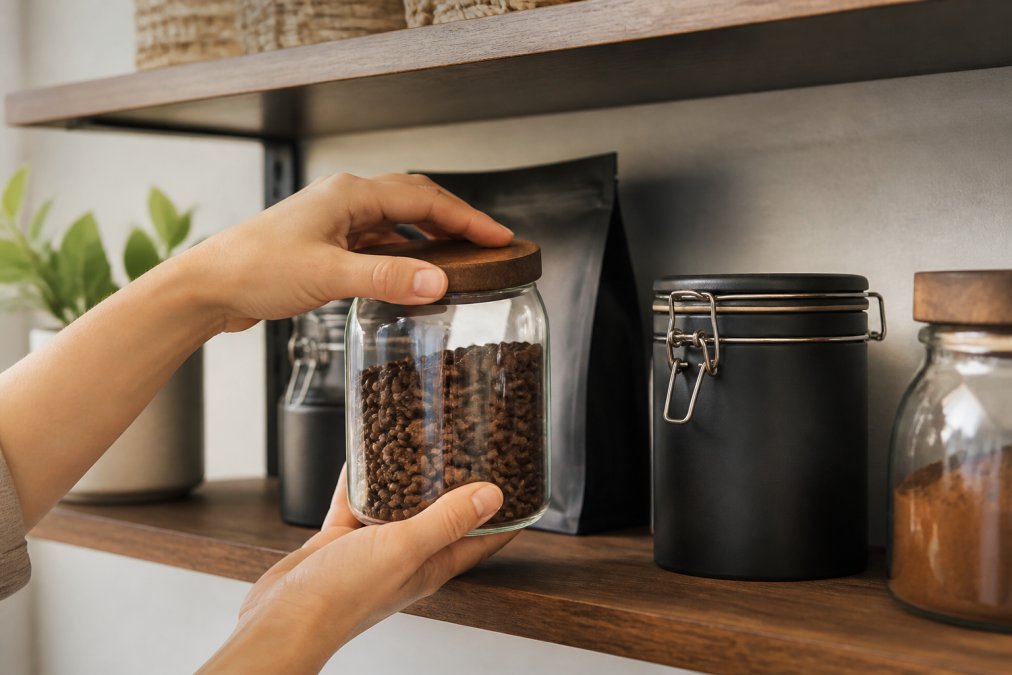
The most reliable method for storing coffee beans is an opaque, airtight container in a cool, dark place, transferring only what you will use in a week or two into a daily-use canister.
Step 1: Keep the Original Bag for Short-Term Storage
If you plan to finish the bag within two to three weeks, the original packaging is often the best container you already own. Good coffee bags have an opaque exterior, a one-way valve, and a resealable top. Fold the top down, press the seal closed, and store the bag in a pantry away from the stove and heat-generating appliances.
Step 2: Transfer to an Airtight Container for Daily Use
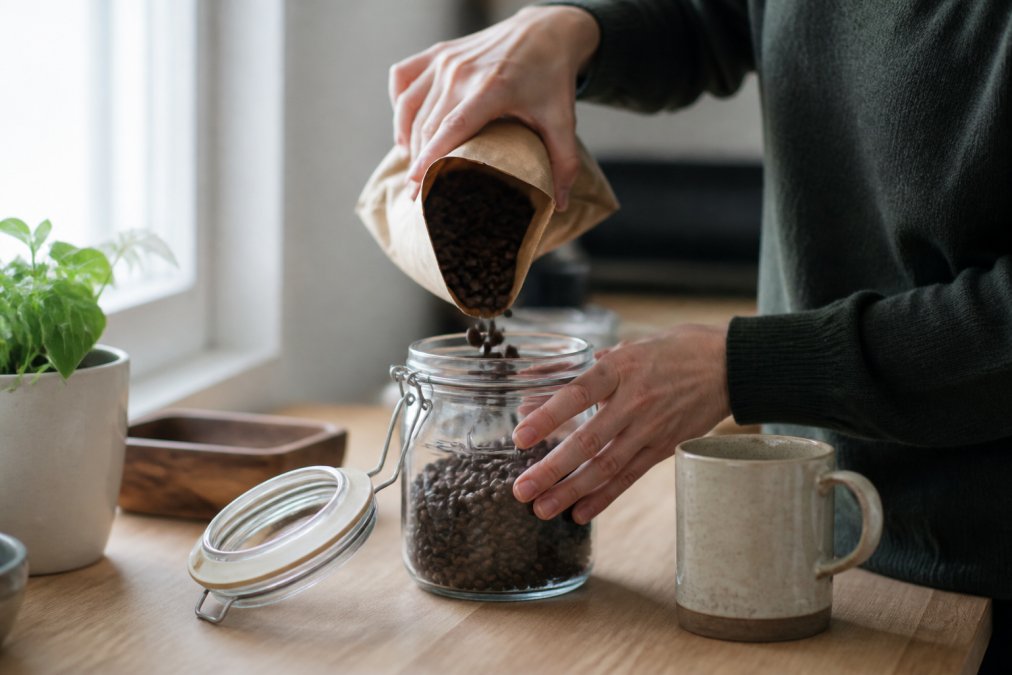
For daily brewing, portion about a week's worth of beans into an airtight canister. An opaque ceramic or stainless steel container blocks light, and a tight gasket seal limits air exchange. Fill it close to the top, since trapped air drives oxidation.
Choosing the Best Coffee Storage Canisters
The best coffee storage canisters share three traits: they block light, seal airtight, and hold roughly a week of beans. Everything else, shape, finish, brand, is preference.
Here is how the main material options compare:
| Material | Light Protection | Air Seal | Best For |
|---|---|---|---|
| Stainless steel | Excellent | Excellent with gasket | Daily use, most kitchens |
| Opaque ceramic | Excellent | Good with tight lid | Countertop display |
| Dark glass | Moderate | Good with gasket | Short-term storage |
| Clear glass | Poor | Varies | Not recommended for beans |
| Original bag | Excellent | Good with valve | First two to three weeks |
Why Stainless Steel and Opaque Ceramic Win
Stainless steel is the strongest all-around choice: it blocks light completely, resists odors, and does not absorb flavors. Look for a silicone or rubber gasket inside the lid, because the gasket, not the lid material, creates the airtight seal. A stainless steel canister with a loose lid is no better than a decorative jar.
Sizing, Headspace, and the Two-Container System
A canister that holds about a week of beans is the sweet spot for daily use. Too small and you refill constantly, opening the main supply more often; too large and you create excess headspace that accelerates oxidation. A one-quart canister holds roughly a pound of whole beans when filled close to the top, about right for a week of daily brewing for one or two people.
The Gilded Café White Glossy Ceramic Mug →
Sustainable and Zero-Waste Options
For the cup itself, a well-sealed canister paired with a mug you actually enjoy using makes the ritual worth it. The Gilded Café White Glossy Ceramic Mug is an 11 oz option that fits a standard pour-over or drip serving, and it is dishwasher and microwave safe for everyday use.

Freezing Coffee Beans: When and How to Do It Right
Freezing coffee beans works well if you do it correctly, and it is one of the most misunderstood techniques in home coffee. The freezer slows oxidation and preserves aromatics far better than room-temperature storage, but only when the beans are protected from moisture and thawed properly.
The method matters:
- Divide the beans into portions you will use in one to two weeks.
- Seal each portion in an airtight, vacuum-sealed, or well-pressed bag.
- Label each portion with the roast date.
- Freeze immediately and do not open the bag until you are ready to use it.
- Let the sealed portion come to room temperature before grinding.
Understanding Coffee Bean Shelf Life
Coffee bean shelf life is not a single number. It is a range shaped by roast level, packaging, and handling after opening. Most whole beans taste best within two to four weeks of the roast date, though that window can shrink to ten days or stretch to six weeks. After peak, flavor flattens gradually, losing sweetness and complexity first, then body, then origin character.
How Roast Level Changes the Clock
Roast level is the most underrated variable in shelf life. Dark roasts are roasted longer and hotter, pushing oils to the bean surface, and those surface oils are the first thing oxygen attacks, so dark roasts stale faster than lighter roasts, often by several days to a week. They also degas more aggressively, which is why a dark roast bag puffs up quickly and the one-way valve matters more.
Visual and Sensory Indicators of Stale Beans
You do not need a date stamp to know if beans are past their prime. Fresh whole beans carry a slight sheen from surface oils and smell sweet, complex, and roastery-like when you open the bag. Stale beans look dull and matte and smell flat, papery, or faintly like cardboard. If a ground pinch gives almost no aroma, the volatile compounds are largely gone.
Climate, Altitude, and Humidity
Most storage guides assume a temperate kitchen, but where you live changes the math. In humid climates, ambient moisture is the dominant threat: every time you open a container, humid air enters and condenses on cooler beans, accelerating staling and encouraging mold. There, the airtight seal matters more than the material, and portioning into smaller containers is worth the extra step.
Common Coffee Storage Mistakes and Myths
The biggest storage myth is that the refrigerator keeps coffee fresh. It does the opposite. Temperature fluctuations and ambient moisture accelerate staling, and coffee absorbs surrounding odors easily, which is why a fridge full of leftovers is the worst possible home for your beans.
Other frequent mistakes:
- Storing beans in a clear jar on an open shelf, exposed to light and air
- Grinding a full week's worth at once, which multiplies the surface area exposed to oxygen
- Leaving beans in the grinder hopper for days
- Buying large bulk bags that will not be finished within a month
- Using a container that is too large, leaving excess headspace
Frequently Asked Questions
What is the best way to store coffee beans for long-term use?
For long-term storage, keep coffee beans in an airtight, opaque container in the freezer. Divide beans into small portions so you only thaw what you need. This limits air exposure and moisture. A vacuum seal helps preserve volatile compounds. Always let frozen beans come to room temperature before grinding to avoid condensation. Properly stored, coffee bean shelf life can extend to several months in the freezer.
Is it better to store coffee beans in glass or plastic?
Glass is better than plastic for coffee storage. Glass is non-porous, so it does not absorb oils or odors, and it does not retain flavors from previous contents. Plastic can scratch and hold onto stale coffee oils over time. Choose an opaque glass canister or keep a clear one in a dark pantry. Both glass and plastic work if airtight, but glass offers better long-term freshness and is easier to clean thoroughly.
Does light exposure affect the flavor of coffee beans?
Yes. Direct sunlight and bright kitchen lights speed up oxidation of the oils in coffee beans. This causes stale, cardboard-like flavors. Store beans in an opaque container or keep a clear canister inside a closed pantry cabinet. Light is one of the four main enemies of freshness, along with heat, moisture, and air. Even short exposure to strong light can degrade aroma and flavor profile over time.
How does oxygen impact the shelf life of roasted coffee?
Oxygen reacts with the oils and volatile compounds in roasted beans, causing oxidation that leads to stale flavors. The more air exposure, the faster this happens. That is why an airtight container with a one-way valve is important: it lets carbon dioxide escape during degassing without letting oxygen in. Reducing air exposure is the single most effective way to extend coffee bean shelf life after roasting.