 how-to
Signs of Truly Fresh Coffee Beans: 2026 Guide
Table of Contents
- Why Freshness Changes Everything in Your Cup
- 1. The Roast Date Tells the Real Story
- 2. Visual Inspection of Beans: Oils, Sheen, and Color
- 3. Aroma and Fragrance Testing: What Your Nose Knows
- 4. Taste Profile Indicators: Acidity, Sweetness, Body, and Mouthfeel
- 5. Coffee Bloom Explained: The CO2 Test for Freshness
- 6. Coffee Roast Date vs Expiration Date: Which One Matters?
- 7. How to Store Coffee Beans for Maximum Freshness
- Frequently Asked Questions
Last Updated: September 18, 2026
Why Freshness Changes Everything in Your Cup
Fresh coffee beans peak within days of roasting, not months. This guide from The Gilded Cafe' Co. breaks down the signs that tell you whether your beans are truly fresh or quietly going stale.
Coffee is organic material.
1. The Roast Date Tells the Real Story
The roast date is the single most reliable freshness marker on any bag, not the expiration date, not a "best by" stamp.
Here's what to look for:
- A printed roast date, not just a month and year
- A date within the last two to four weeks for peak flavor
- Beans roasted more than six weeks ago that will taste flatter
2. Visual Inspection of Beans: Oils, Sheen, and Color
Fresh beans look different from old ones, and color and surface texture tell you a lot before you brew. But what counts as "normal" depends on the roast level, the processing method, and the bean's density. Reading surface oils without that context leads to false alarms.
The baseline: roast level sets the clock
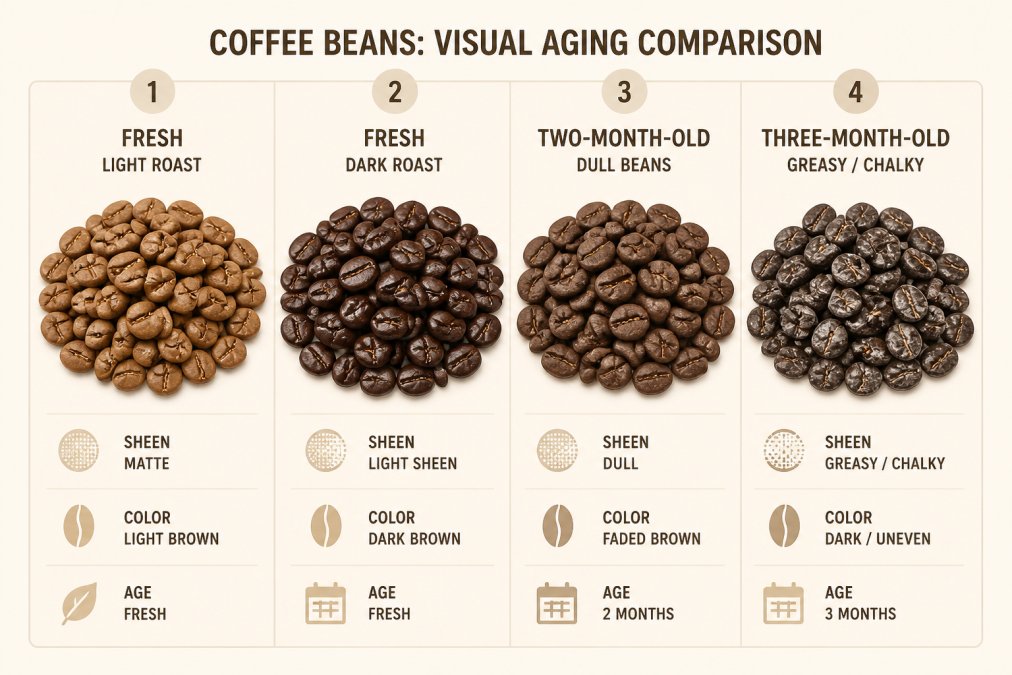
Dark roasts show surface oil sooner; light roasts stay matte longer. How to read what you see:
- Fresh, lighter roasts: dry, matte surface with even color
- Fresh, darker roasts: a light sheen or small oil spots
- Old beans: dull, faded color or a heavy, greasy coating
- Stale beans: a chalky or dusty look
Why processing method changes the picture
Two beans roasted to the same level on the same day can look completely different on the shelf, thanks to the processing method, how the fruit was removed before drying.
- Washed (wet-processed) beans: The fruit is stripped off before drying, so the seed surface is clean. These beans tend to look matte and uniform, and they show surface oil later. A washed bean with a sudden heavy sheen is a stronger staleness signal than the same sheen on a natural.
- Natural (dry-processed) beans: The fruit dries onto the seed, leaving sugars and residues on the surface. Naturals often look slightly darker, stickier, or more uneven even when fresh, and they can show a faint sheen earlier. Don't read that sheen as age on its own.
- Honey and semi-washed beans: Sit between the two. Expect a slightly tacky surface that's normal for the process, not a freshness warning.
Bean density: the variable you can feel
Density is set by growing altitude and variety, and it affects how a bean roasts and ages. High-grown, denser beans (common in East African and high-altitude Central and South American lots) roast more evenly and hold up longer; lower-density beans age faster and show surface changes sooner.
A quick visual timeline
- Days 1-7: Even color, matte to light sheen depending on roast and process. Little to no surface oil on lighter roasts.
- Weeks 2-4: Peak window for most beans. Darker roasts may show small oil spots; lighter roasts stay matte.
- Weeks 5-8: Color starts to dull. Oils spread on darker roasts. Aromatics noticeably weaker.
- Months 2-3: Faded, flat color. Heavy or greasy coating on dark roasts, chalky look on light roasts. Flavor is muted.
3. Aroma and Fragrance Testing: What Your Nose Knows
Aroma is the fastest freshness test. Open the bag and breathe in: fresh coffee beans smell sweet, complex, and alive; old beans smell flat or papery.
Try this:
- Open the bag and smell the whole beans
- Grind a small amount and smell again
- Compare the two
4. Taste Profile Indicators: Acidity, Sweetness, Body, and Mouthfeel
Your palate confirms what your eyes and nose suspect: fresh coffee tastes lively and vibrant, stale coffee muted and flat.
Look for these taste markers:
Best Sellers Sample Pack: 6Bean →
- Acidity: bright, crisp, and lively, not sour or sharp
- Sweetness: natural, not sugary, with clear notes
- Body: a full, round mouthfeel, not thin or watery
- Texture: smooth, not gritty or dry
5. Coffee Bloom Explained: The CO2 Test for Freshness
Coffee bloom explained simply: the bubbling and foaming when hot water hits fresh grounds. That foam is carbon dioxide escaping, fresh beans hold more CO2, so they bloom more.
- Grind a scoop of beans fresh
- Place the grounds in your dripper or French press
- Pour hot water over them and watch
The chemistry behind the bloom
Roasting builds pressure inside the bean. Heat drives off moisture and traps carbon dioxide in the bean's cell structure; after the roast, that CO2 works its way out, a process called degassing.
- Days 1-3: Very high CO2. Blooms are explosive, and espresso can taste sharp or gassy because the gas interferes with extraction.
- Days 4-14: CO2 still high but tapering. This is the sweet spot for most brew methods, enough gas for a lively bloom, not so much that it disrupts the shot.
- Weeks 3-6: CO2 mostly gone. Blooms get thin. Flavor starts to flatten.
- Past 6 weeks: Little to no bloom. The bean has also taken on oxygen, which is what actually stales the coffee.
The bloom test by brew method
Freshness signs aren't identical across brewers. The same beans can bloom dramatically in one method and look flat in another.
- Pour-over (V60, Chemex, dripper): The bloom is most visible here. Expect a domed, bubbling bed that rises and settles. A thin, quiet bed on beans under two weeks old usually means the grind is too coarse or the water too cool, not that the beans are stale.
- French press: You'll see a thick foam cap and hear the grounds crackle. Fresh beans push the crust up hard. Old beans barely crust.
- Espresso: Bloom shows up as crema, not foam on a bed. Fresh beans give a thick, persistent crema with visible bubbles; very fresh beans can give too much and taste gassy. Crema that's thin, pale, and gone in seconds points to old beans, or a grind and pressure problem.
- AeroPress and moka: Bloom is subtle. Look for a small rise and light bubbling when water first hits the grounds. Don't expect a pour-over-style dome.
When the bloom lies
A few things can fake a weak bloom even on fresh beans:
- Grind too coarse: Less surface area means less CO2 released at once.
- Water too cool: Below roughly 195°F, the reaction slows and the bloom shrinks.
- Stale-tasting but gassy beans: Beans stored in a sealed bag can hold CO2 longer than they hold flavor. A decent bloom doesn't guarantee a good cup.
6. Coffee Roast Date vs Expiration Date: Which One Matters?
The roast date matters; the expiration date usually doesn't. Coffee roast date vs expiration date is worth settling, because the two tell very different stories.
| Label | What It Tells You | What to Trust |
|---|---|---|
| Roast date | When beans were roasted | Best freshness marker |
| Expiration date | Seller's shelf-life guess | Rarely useful |
| "Best by" date | A rough estimate | Weak signal |
| No date at all | Nothing | Avoid |
7. How to Store Coffee Beans for Maximum Freshness
Here's a storage routine that works:
- Keep beans in an airtight container
- Store away from light and heat
- Skip the fridge for daily use
- Buy whole bean and grind fresh
- Use a bag with a one-way valve if you keep the original packaging
For a simple way to test your own setup, grab a sample pack and run the bloom test on each batch. Our Best Sellers Sample Pack includes six small packs, so you can compare freshness across roasts without committing to a full bag.

Frequently Asked Questions
How do you tell if your coffee beans are fresh?
Start with the roast date on the bag. Fresh coffee beans show a visible sheen without heavy oil pooling, smell sweet and complex when you open the bag, and produce a thick, foamy bloom when hot water hits the grounds. If the beans smell flat, papery, or like cardboard, they have likely oxidized. For best results, buy whole bean coffee roasted within the last two to four weeks and grind right before brewing.
What are the signs of stale coffee beans?
Stale coffee beans lose their aroma and develop a muted, papery, or cardboard-like smell. The beans may look dry and faded, with no oil sheen. When brewed, the cup tastes flat and bitter with no sweetness or acidity. The bloom will be thin or nonexistent because most carbon dioxide has already escaped. If your coffee tastes dull no matter how you brew it, the beans are past their peak.
Does the roast date on a bag really matter?
Yes. The roast date tells you exactly when the beans were roasted, which is the single best indicator of freshness. Unlike an expiration date, which is often set months out, the roast date lets you judge how much time has passed since roasting. For peak flavor, use beans within two to four weeks of the roast date. After that, oxidation and degassing reduce aroma, sweetness, and complexity.
How does the bloom indicate coffee freshness?
The bloom is the foamy layer that forms when hot water hits coffee grounds. It happens because freshly roasted beans release carbon dioxide, a byproduct of roasting. The bigger and more active the bloom, the more CO2 is still trapped inside, which signals recent roasting. A weak or flat bloom means most gas has already escaped, so the coffee is likely older and less flavorful. This makes the bloom a quick, reliable freshness test.